CF-BEU
CF-BEU – Historical Photos / Photos Historiques

|
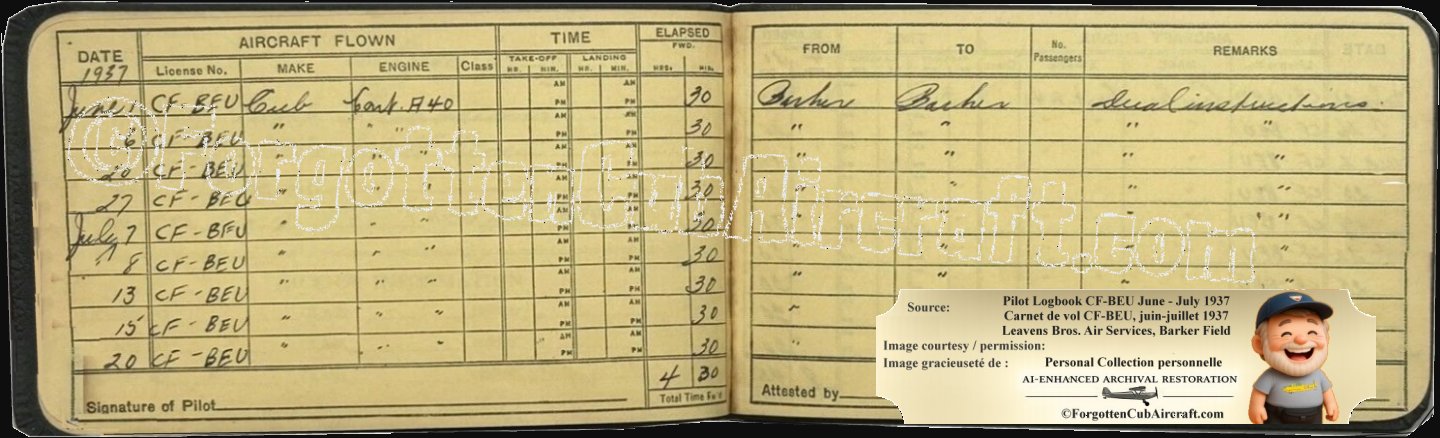
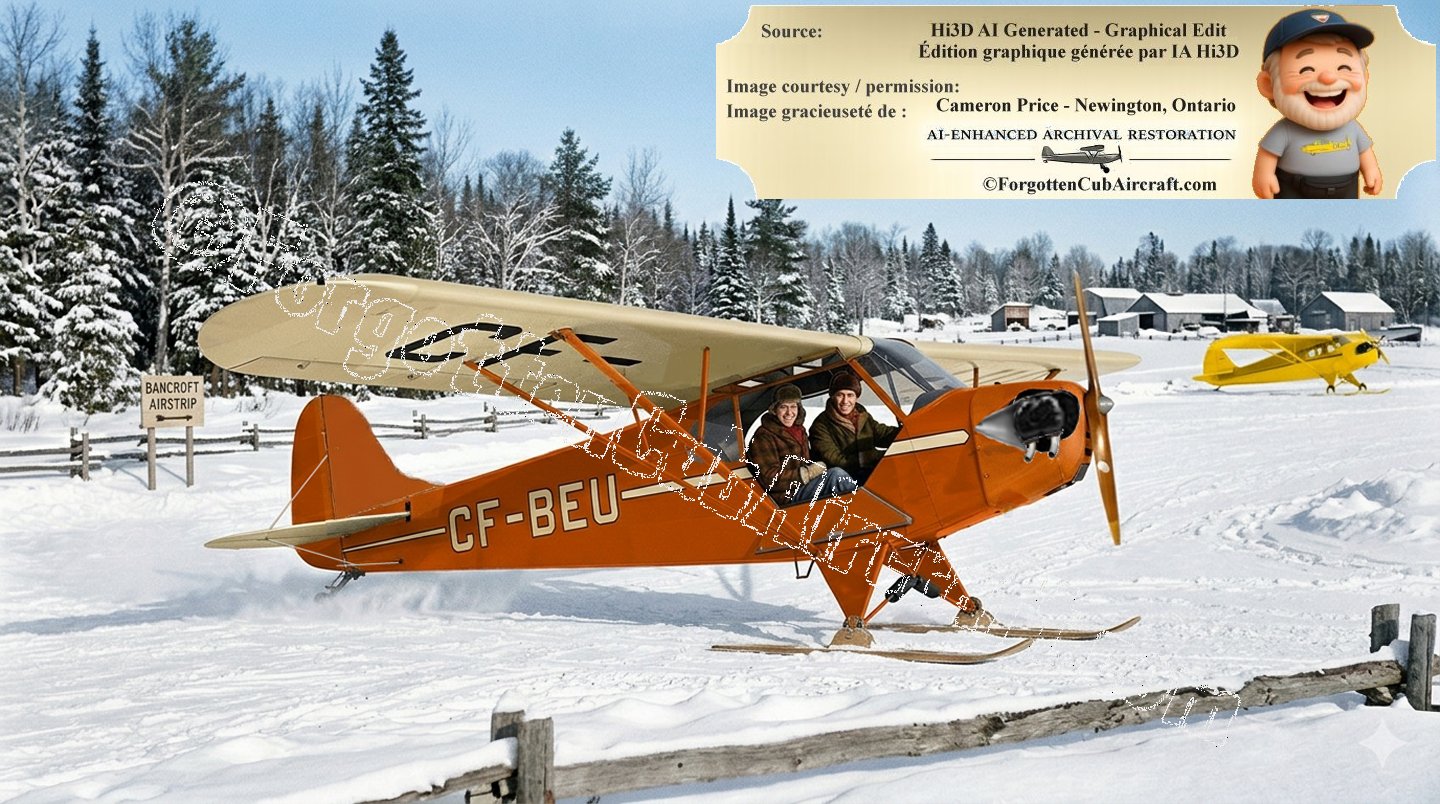
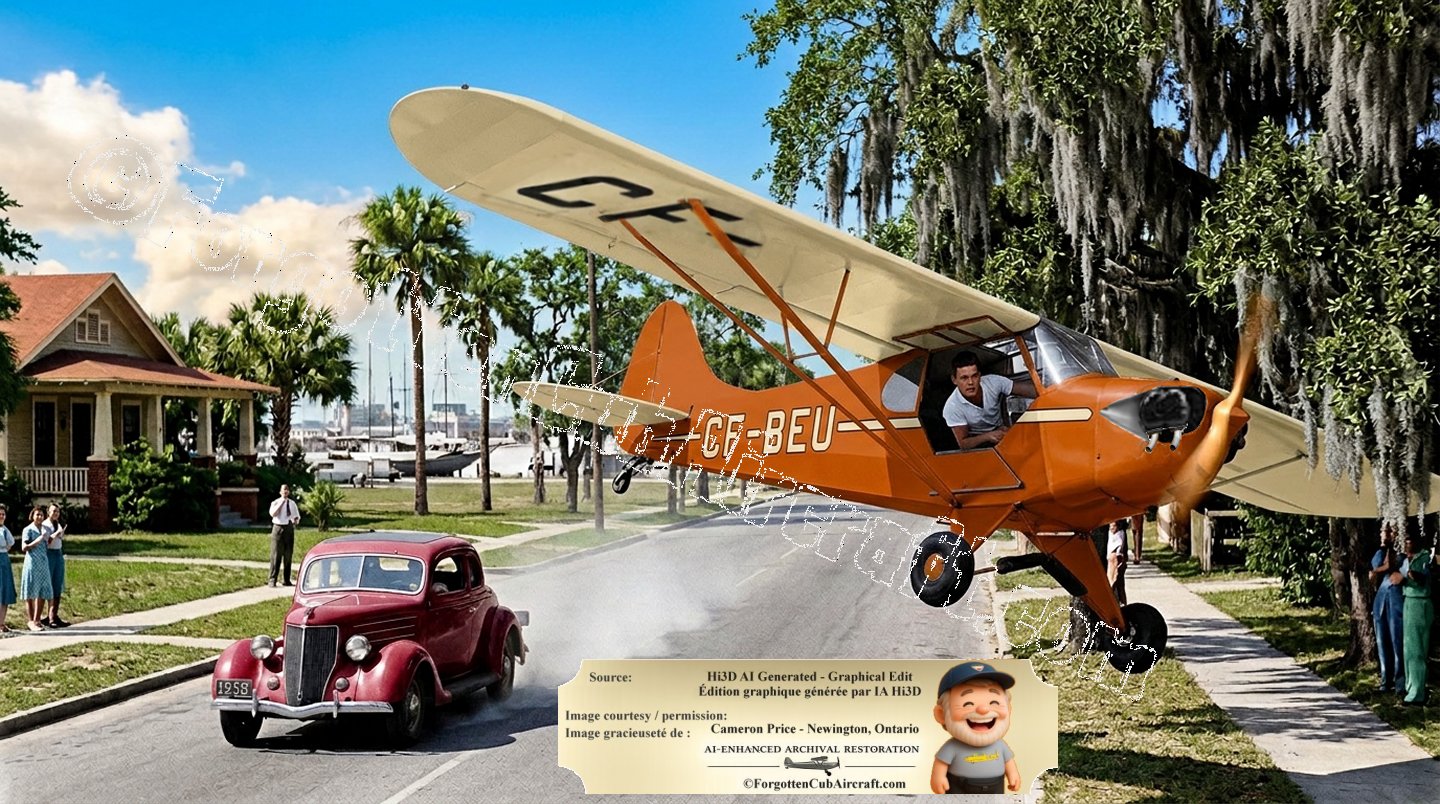
Notes: CF-BEU c/n C-1105 was registered May 11, 1937 to Leavens Bros. Barker Field, Toronto, Ontario. CF-BEU had the A-40-4 engine rated at 2550 rpm to satisfy the 37 hp restriction. The second and last owner was Hillier Thompson, registered January 20, 1938 at Northbrook, Ontario. He obtained a "touring permit" allowing him to take CF-BEU to the Albert Whitted Airport, St. Petersburg, Florida's primary aviation hub, located right on the waterfront downtown. On March 21, 1938, he was flying dangerously low down an asphalt residential street recklessly drag-racing a 1930s coupe, driven by his sister Velva on the street below. Suddenly the aircraft banked sharply, its wingtip perilously hitting a massive roadside live oak tree draped in Spanish moss, in the bright, high-contrast Florida afternoon sun. The American Civil Aeronautics Authority seized CF-BEU for unpaid duties and the Canadian DoT cancelled his Civilian Pilot Certificate for one year. Hillier was also permanently forbidden from flying an aircraft in the United States. Comments by Cameron Price: I am particularly interested in the history of Hillier since I am very familiar with the area where he flew CF-BEU. My mother was born 50 km north of Northbrook, Ontario. In fact my first aircraft flight, coincidentally also in 1955 was on the Mazinaw Lake, equidistant between both locations. Hillier obtained his civilian pilot's license from Leavens Bros. in late 1937, then buying the Taylor J-2 he learned to fly on, using CF-BEU to barnstorm. In February 1938 he decided to fly to St. Petersburg, Florida to visit his sister. The Ski Takeoff: He actually drove north to Bancroft, Ontario, where he took off in CF-BEU using skis on the winter snow. The Wheel Swap: He flew the ski-equipped Cub south to the Kingston Flying Club, where he finally swapped the skis out for standard landing wheels. The Flight South: From Kingston, he officially cleared U.S. Customs at Cape Vincent, New York, reaching Endicott, NY the first day. He was accompanied by a friend James Maxwell. Next day, in dense fog they were forced to land at the military Washington Army Field. Although civilian aircraft were not allowed to land at this field, I suspect with the aircraft's colour and origin, maps and assistance were given to the Canadian aviators to complete the remaining multi-day flight along the Eastern Seaboard to reach Florida. While in Florida, they attended an air meet in Orlando, Florida receiving the "keys" to the city and feted as welcome guests. The accident and events are described above, where CF-BEU remained. Following the Florida accident, Hillier returned to Northbrook where his father built an airfield on the Lloyd farmstead in Northbrook to continue his barnstorming in a Fleet Finch. He then enrolled at the Crumlin Training School, graduating as a qualified pilot for R.A.F. Ferry Command, piloting over 55 heavy bombers across the Atlantic ocean. He returned to flying after setting up a business in Toronto, Ontario with his Hamilton wife. Sadly Captain Hillier 'Jake' Thompson died in a 1955 crash while flying an aircraft for a 950 km flight from Edmonton, Alberta to Yellowknife, North West Territories (N.W.T.). He was flying for Associated Airways on behalf of the Canadian/American "Defence Early Warning" system, referred to as the "DEW Line". Content compiled from the Spring/Summer 2022 edition of The Cloyne and District Historical Society. ================================================================================================== Remarques: CF-BEU n/c C-1105 a été immatriculé le 11 mai 1937 à Leavens Bros., Barker Field, Toronto, Ontario. CF-BEU était équipé du moteur A-40-4 régime nominal de 2550 tr/min pour satisfaire à la restriction de 37 ch. Le deuxième et dernier propriétaire fut Hillier Thompson, enregistré le 20 janvier 1938 à Northbrook, Ontario. Il obtint un "permis de voyage" lui permettant d'emmener CF-BEU à l'aéroport Albert Whitted, St. Petersburg, principal centre d'aviation de la Floride, situé directement sur le front de mer au centre-ville. Le 21 mars 1938, il volait dangereusement bas au-dessus d'une rue résidentielle asphaltée, faisant une course effrénée contre un coupé des années 1930, conduit par sa sœur Velva en bas sur la rue. Soudain, l'appareil s'inclina brusquement, son bout d'aile heurtant dangereusement un énorme chêne vert en bordure de route drapé de mousse espagnole, dans le soleil éclatant et très contrasté de l'après-midi floridien. L'Autorité américaine de l'aéronautique civile (Civil Aeronautics Authority) saisit CF-BEU pour droits impayés et le ministère canadien des Transports annula son certificat de pilote civil pour un an. Hillier fut également interdit de façon permanente de piloter un aéronef aux États-Unis. Commentaires de Cameron Price: Je m'intéresse particulièrement à l'histoire de Hillier car je connais très bien la région où il a piloté CF-BEU. Ma mère est née à 50 km au nord de Northbrook, Ontario. En fait, mon premier vol en avion, par coïncidence aussi en 1955, a eu lieu sur le lac Mazinaw, à égale distance des deux endroits. Hillier a obtenu sa licence de pilote civil chez Leavens Bros. à la fin de 1937, puis a acheté le Taylor J-2 sur lequel il avait appris à voler, utilisant CF-BEU pour faire du barnstorming. En février 1938, il décida de s'envoler vers St. Petersburg, en Floride, pour rendre visite à sa sœur. Le décollage à skis: Il s'est en fait rendu au nord à Bancroft, Ontario, où il a décollé avec CF-BEU équipé de skis sur la neige hivernale. L'échange des roues: Il a piloté le Cub équipé de skis vers le sud jusqu'au Kingston Flying Club, où il a finalement remplacé les skis par des roues d'atterrissage standard. Le vol vers le sud: De Kingston, il a officiellement passé la douane américaine à Cape Vincent, New York, atteignant Endicott, NY le premier jour. Il était accompagné d'un ami, James Maxwell. Le lendemain, dans un brouillard dense, ils ont été forcés d'atterrir au terrain militaire de Washington Army Field. Bien que les avions civils n'aient pas été autorisés à atterrir sur ce terrain, je soupçonne qu'en raison de la couleur et de l'origine de l'appareil, des cartes et de l'assistance ont été fournies aux aviateurs canadiens pour terminer le vol de plusieurs jours le long de la côte est afin d'atteindre la Floride. Pendant leur séjour en Floride, ils ont assisté à un rassemblement aérien à Orlando, en Floride, recevant les "clés" de la ville et fêtés comme invités de marque. L'accident et les événements sont décrits ci-dessus, où CF-BEU est resté. Suite à l'accident de Floride, Hillier est retourné à Northbrook où son père a construit un aérodrome sur la ferme Lloyd à Northbrook pour poursuivre son barnstorming à bord d'un Fleet Finch. Il s'est ensuite inscrit à la Crumlin Training School, obtenant son diplôme de pilote qualifié pour le R.A.F. Ferry Command, pilotant plus de 55 bombardiers lourds à travers l'océan Atlantique. Il est revenu au pilotage après avoir établi une entreprise à Toronto, Ontario, avec son épouse de Hamilton. Malheureusement, le capitaine Hillier 'Jake' Thompson est décédé dans un écrasement en 1955 alors qu'il pilotait un appareil pour un vol de 950 km d'Edmonton, Alberta à Yellowknife, Territoires du Nord-Ouest (T.N.-O.). Il volait pour Associated Airways pour le compte du système canado-américain "Defence Early Warning", appelé la "ligne DEW". Contenu compilé à partir de l'édition printemps/été 2022 de la Cloyne and District Historical Society. |
⏎ CCAR CF-BEU